Math zines at MathFest
MAA MathFest 2025, Sacramento
A selection of my math zines was featured in the “Mathematical Art” exhibit at the Mathematical Association of America’s annual “MathFest” conference (in 2025 in Sacramento, from August 6th to 9th). There were 100 copies each of “\(i^i\) is Punk”, “Six Short Stories About the Binomial Theorem,” and a last-minute one-sheet zine about the derivation of the derivative of inverse tangent.
Here’s how they looked on the table:
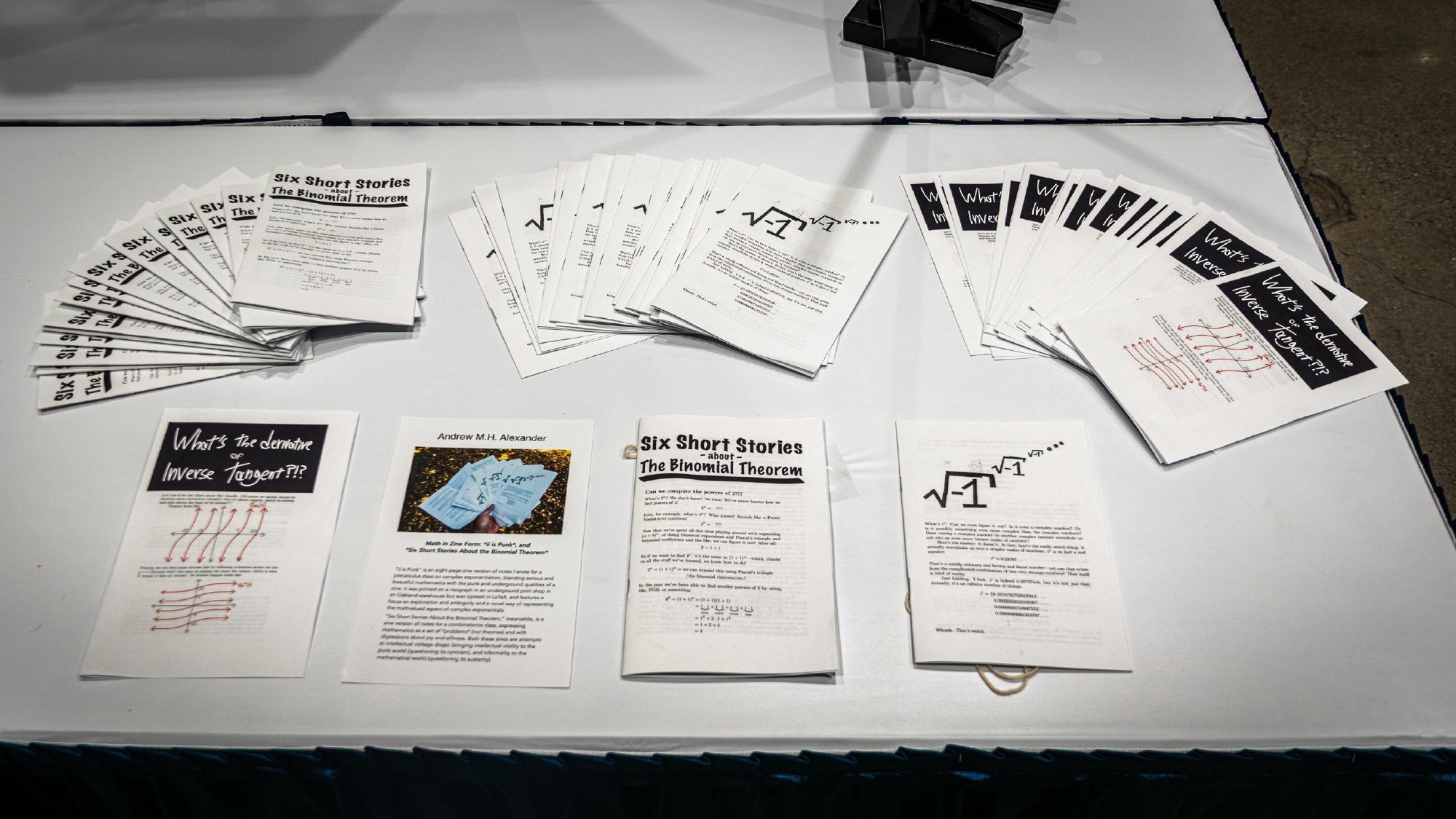
The description I wrote was:
“\(i^i\) is Punk” is an eight-page zine version of notes I wrote for a precalculus class on complex exponentiation, blending serious and beautiful mathematics with the punk and underground qualities of a zine. It was printed on a risograph in an underground print shop in an Oakland warehouse but was typeset in \(\LaTeX\), and features a focus on exploration and ambiguity and a novel way of representing the multivalued aspect of complex exponentials. “Six Short Stories About the Binomial Theorem” is likewise a zine version of notes for a combinatorics class, expressing mathematics as a set of problems (not theories) and with digressions about joy and silliness. Both these zines are attempts at intellectual voltage drops: bringing intellectual vitality to the punk world (questioning its cynicism), and informality to the mathematical world (questioning its austerity).
For the catalog, I had to write an artist’s statement:
As a writer and expositor of mathematics, I seek to write mathematics in a way that’s humane: respectful of our human finitude and fondness for storytelling. How do we write about abstract objects in ways that bring out their plots and subplots, their characters and themes, their tensions and climaxes and ambiguities? How do we write in a way that helps readers share in the joy and excitement of discovery and exploration? How do we decide when to speak in general terms, and when to use a more specific example representative of the general principle? Traditional mathematical writing prizes concision, precision, and abstraction (and a lack of redundancy). How do we counterbalance these supposed ideals, and explore different ways of writing mathematics? How do we write mathematics in a way that uses the full power of literature and language? (Among the many things that result from this approach is the opening up of the world of mathematics to those who might have otherwise avoided the subject because of its austerity.) As a teacher, I’ve spent a decade writing DIY textbooks for nearly every course I’ve ever taught, trying to explore as fully as I can the possibility space of the intersection of mathematics and the English language.
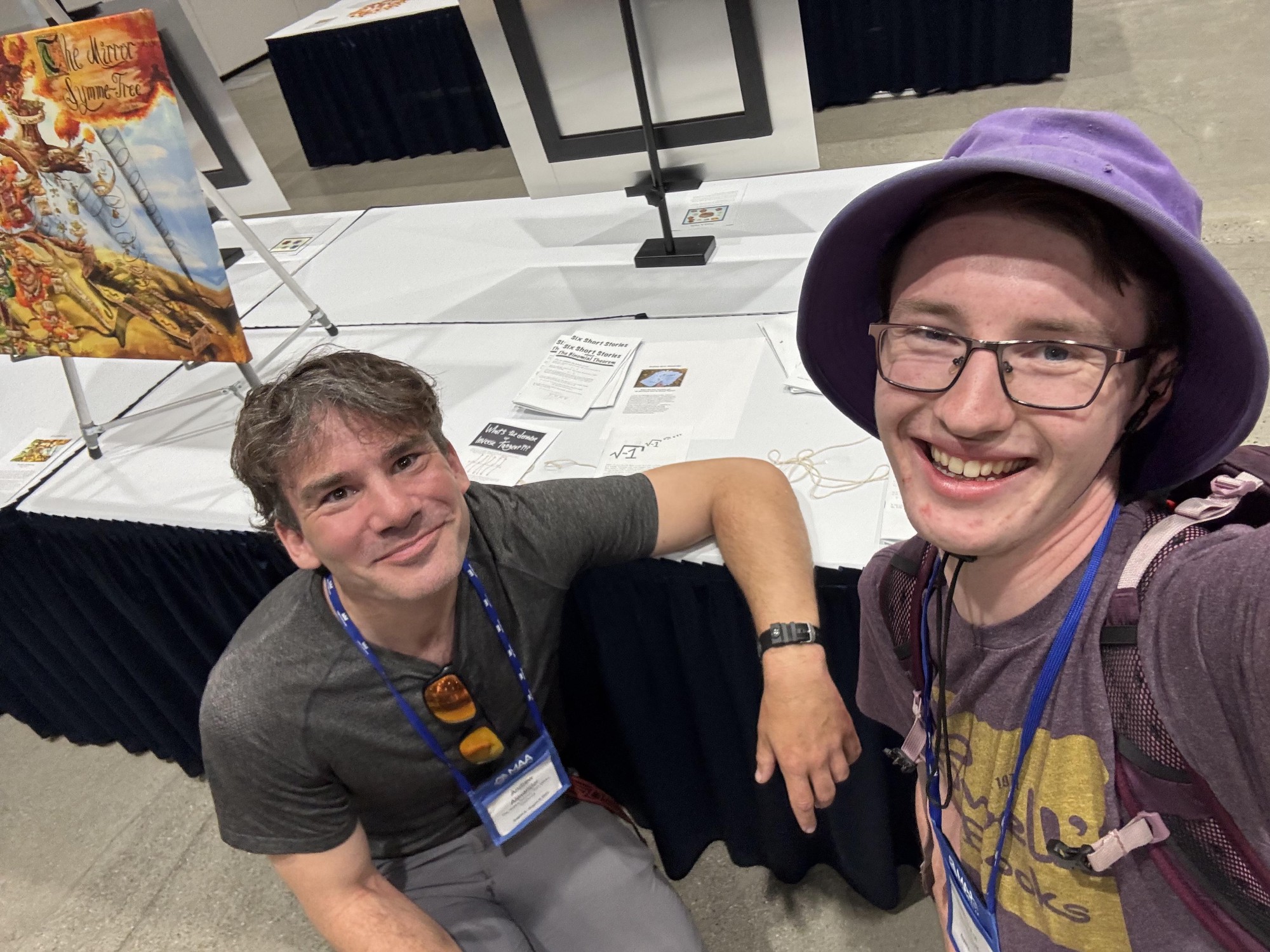
Former student Kaden Knight wanted a selfie by the exhibit: